Politics
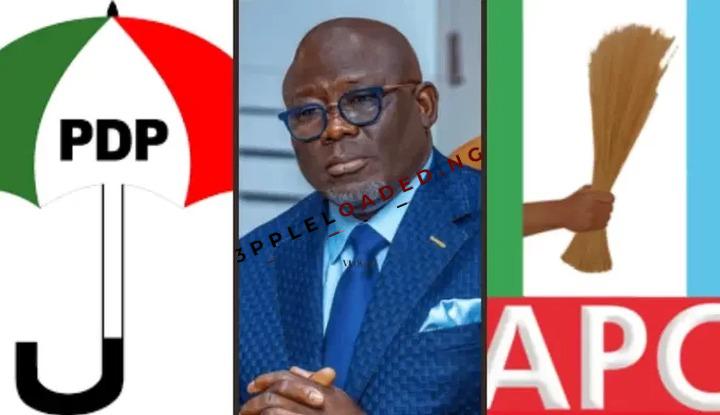
Peoples Democratic Party (PDP) Sues Oborevwori, INEC to Court over Defection to APC
The Peoples Democratic Party (PDP) has been dragged into a fresh legal battle following the defection of Delta State Governor, Sheriff Oborevwori, to the All Progressives Congress (APC).....TAP TO CONTINUE READING
A member of the PDP in Delta State has asked the Federal High Court in Abuja to declare the governor’s defection unconstitutional while he remains in office.
The suit was filed by Alex Akporute, a PDP member from Ward 3/7 in Ughelli North Local Government Area of Delta State.
He approached the court through an originating summons, challenging the legality of Oborevwori’s move from the PDP to the APC.
In the suit, Governor Oborevwori is listed as the 1st defendant.
Other defendants include the PDP, the APC, the Independent National Electoral Commission (INEC), and the Attorney-General of Delta State.
The case, marked Suit No: FHC/ABJ/CS/2601/2025, was filed on December 3, 2025.
Court documents show that all parties were served with hearing notices on December 17, 2025.
The matter has now been assigned to Justice Omotosho of the Federal High Court, Abuja Division.
The plaintiff is asking the court to determine four major constitutional issues.
Central to the case is whether a sitting governor can defect to another political party and still retain the electoral mandate won on the platform of his former party.
Akporute argues that while the Constitution guarantees freedom of association, that right does not extend to transferring an electoral mandate from one political party to another.
He insists that the mandate belongs to the PDP, under which Oborevwori contested and won the governorship election.
The plaintiff also questions whether the governor’s defection undermines the will of the electorate who voted for the PDP in Delta State.
According to him, allowing such a defection without consequences weakens democratic principles and the supremacy of the people’s votes.
In his claims, Akporute maintains that Oborevwori’s continued stay in office while aligning with the APC breaches several provisions of the 1999 Constitution and the Electoral Act 2022.
He insists that the governor cannot lawfully promote or implement APC policies, having not been elected on that platform.
Among the reliefs sought is a declaration that the governor’s constitutional rights cannot be exercised in a way that conflicts with the electoral mandate given to the PDP by voters in Delta State.
The plaintiff also wants the court to declare that any executive action taken by Oborevwori on the platform of the APC is unconstitutional and legally invalid.
The suit further seeks an order restraining the APC from presenting itself as the ruling party in Delta State while Oborevwori remains in office as governor.
Akporute is also asking the court to nullify Oborevwori’s membership of the APC, on the grounds that his defection violates both the Constitution and the Electoral Act.
In a key argument, the plaintiff contends that Section 40 of the Constitution, which guarantees freedom of association, can only apply to Oborevwori after he resigns as governor or after his tenure ends on May 29, 2027.
However, the case is different from previous suits against defecting governors.
Unlike earlier cases where plaintiffs asked the court to compel governors to vacate office, this suit focuses on restricting the political and executive consequences of defection while in office.
The legal action comes at a time when Governor Oborevwori has been openly participating in APC activities, including attendance at high-level party meetings.
Read The Full Article Here Now
👉 Are You A WhatsApp User? Do You Want To Get Our News As Fast As Possible On Daily Basis? 👉 Click This Link To Join WhatsApp Channel Now.
Art & Commercial students don’t fail JAMB because they’re dull. They fail because they’re taught like Science students. Science students calculate — JAMB rewards that. Art students explain — JAMB doesn’t. So you read hard, attend lessons, yet your score disappoints you. This online class fixes that. No theory overload. No confusion. Just real JAMB questions, clear breakdowns, and winning strategies. 📌 JAMB is not hard — you were just taught the wrong way.Click The Link To Reach Us Now 👉 https://wa.me/2349063958940
Politics
President BAT’s ally, Gilbert Chagoury to handle ₦1.4 trillion Lagos ports project
Indications have emerged that ITB Nigeria, a construction firm owned by a Lebanese-Nigerian businessman and President Bola Ahmed Tinubu’s longtime associate, Gilbert Chagoury, will execute the renovation contract of Lagos Tin Can and Apapa Ports.....TAP TO CONTINUE READING
Tinubu had, in January, conferred the Grand Commander of the Order of the Niger (GCON), Nigeria’s second highest honour, on Chagoury “because of his contributions to the country.”
Last week, Nigeria and the United Kingdom during a meeting between Prime Minister Keir Starmer and President Tinubu at Downing Street in London, sealed a £746 million export finance deal to support the refurbishment of the two major ports in Lagos.
Checks showed that Chagoury, whose conglomerate operates through the Chagoury Group, was part of the delegation to London where the financing agreement for the Lagos ports refurbishment project was sealed during President Tinubu’s two-day state visit to the UK.
A report by Africa Intelligence in March 2025 had revealed that the Federal Executive Council’s meeting in February 2025 selected Chagoury Group and its subsidiary, ITB Nigeria, for the contract.
The Minister of Marine and Blue Economy, Gboyega Oyetola, had also confirmed on October 22, 2025 that the federal government approved a sum of $1 billion (N1.4 trillion) for the modernisation of the Apapa and TinCan Island seaports in Lagos.
The minister spoke in Lagos at the 2025 Chartered Institute of Logistics and Transport (CILT) Nigeria Conference, with the theme ‘Enhancing Logistics and Transport for a Sustainable Blue Economy in Nigeria.’
Chagoury’s key projects in Nigeria
Chagoury co‑founded the Chagoury Group in Lagos in 1971, building it into a sprawling conglomerate with interests in construction, real estate, hospitality, manufacturing, infrastructure, among others.
Through the Chagoury Group, Gilbert Chagoury has built one of the most influential business empires in Nigeria, with interests spanning construction, manufacturing, real estate, and energy.
The Chagoury Group is handling the N15 trillion 700-kilometer 10-lane Lagos-Calabar Coastal Road project designed to connect Lagos to Cross River State, passing through Ogun, Ondo, Delta, Bayelsa, Rivers and Akwa-Ibom states.
The section one, phase one of the project, handled by Chagoury’s Hitech, has been concluded.
Among its most prominent undertakings is the Eko Atlantic City project, a sprawling urban development built on reclaimed land along the Atlantic coastline.
The initiative has been widely described as a response to coastal erosion and urban expansion pressures in Lagos.
Chagoury Group’s role in delivering Eko Atlantic has earned it recognition as a key player in Nigeria’s infrastructure transformation, though the project has also attracted criticism over environmental and socio-economic concerns.
Key assets constructed by Chagoury included major property developments like Banana Island and ongoing large‑scale projects such as the Eko Atlantic City urban development through South Energyx Nigeria Limited, among others.
Lagos-focused ports upgrade deepens regional imbalance – Experts
The federal government’s plan to channel the United Kingdom-backed loan into the development of Lagos ports has triggered widespread criticisms, with stakeholders accusing the authorities of deepening infrastructural imbalance by prioritising already functional facilities over neglected ones in other parts of the country.
Maritime operators and regional advocates argue that the move underscores a persistent policy tilt towards Lagos, despite repeated calls for the revitalisation of ports in the eastern and Niger Delta corridors, many of which remain underutilised due to years of neglect.
Industry players say the decision to invest fresh loan funds in Lagos, where port activities are already thriving, raises concerns about fairness and strategic planning.
According to them, ports such as Onne, Warri, Calabar and Ibom, and lately Baro Port in northern part of Nigeria, have suffered from poor infrastructure, low draught levels, security concerns and limited connectivity to major economic centres.
The Sea Empowerment and Research Centre (SEREC), in a statement titled ‘Re-balancing Nigeria’s Maritime Future: Integrating Port Decentralisation into National Reform Agenda Amid Lagos-Centric Investments’, signed by its Head of Research, Dr Eugene Nweke, said while the centre acknowledged the economic importance of ongoing upgrades in Lagos ports, it was concerned about “the continued structural neglect of other national port assets” which, according to him, poses long-term risks to trade efficiency, foreign exchange stability and inclusive economic growth.
The centre said it had critically reviewed the government’s recent port infrastructure financing arrangement supported by UK Export Finance, alongside the broader trajectory of Nigeria’s maritime development strategy.
It stated: “Nigeria’s maritime system remains heavily concentrated in Lagos, which currently accounts for the majority of cargo throughput.
“However, this concentration has resulted in persistent congestion and logistics inefficiencies, increased cost of imports and exports, overstretching of port and road infrastructure.
“At the same time, strategic ports in: Port Harcourt, Warri, Calabar and Onne, without mincing words, remain significantly underutilised due to policy neglect, inadequate infrastructure linkages and inconsistent investment priorities.”
The centre said the current port imbalance is not merely a logistics issue, but a macroeconomic concern with direct foreign exchange (FX) implications.
It further stated that overdependence on Lagos ports would ultimately drive up import handling costs and also encourages congestion-induced inefficiencies.
“It will effect port inefficiency and geographic concentration contribute indirectly to pressure on the Naira and Nigeria’s external reserves.
“The federal government’s investment in Lagos port infrastructure—though necessary—reflects a short-term efficiency-driven approach that is inconsistent with broader national objectives of trade facilitation, export diversification and regional economic inclusion,” the statement added.
A maritime expert and former Director of Operations at the Nigerian Maritime Administration and Safety Agency (NIMASA), Captain Warredi Enisuoh, said the government should redesign the available space at the different ports for ports automation, warehouse automation so that “Ñigeria could rake in more money instead of the economy stuck in traffic and ships waiting at anchorage which is the order of the day.”
He said the Nigeria-UK deal “should have been geared towards decentralization and automation which will bring down operational cost of shipping.”
A businessman, Okey Okonkwo, expressed concerns that the government should have considered upgrading ports in other parts of the country as well.
He said: “This deal is a clear example of the federal government’s lack of commitment to developing the Niger-Delta region. We have ports in Warri, Port Harcourt, and Calabar that are in dire need of upgrade, but the government is only focusing on Lagos.”
Lucky Amiwero, a shipping expert and maritime industry activist, also queried the rationale behind signing the loan deal for ports infrastructure upgrade.
Amiwero, who is also the president of the National Council of Managing Directors of Licensed Customs Agents and CEO of Eyis Resources Limited, noted that revenue from the port is more than enough to carry out any upgrade.
He queried what happened to the money realised from terminal operators when the nation’s seaports were concessioned in 2006.
He advised the government to utilise revenue collected from port operations for any future upgrade.
“Having stated all these, the next question is what happens to other ports? Why is government neglecting ports in other regions. Why not make viable them if they are not. It will improve efficiency and eliminate congestion that has bedeviled all the ports in Lagos.
“The government’s focus on Lagos ports is short-sighted and neglects the economic potential of other ports. We need to develop our ports in a way that promotes economic growth and development across all regions, not just Lagos,” he said.
Ohanaeze Youth Council alleges marginalisation of S/East
The Ohanaeze Youth Council, in a statement yesterday by its president, Igboayaka Igboayaka, alleged that the Nigerian government’s £747million port rehabilitation agreement with the UK was a further indication of the “marginalisation” of the South-East.
The council warned that the continued neglect of seaport infrastructure in Igbo-dominated areas could deepen separatist sentiments.
It alleged that the focus on Lagos ports ignored what it described as historically viable maritime locations in the South-East, including Ose-Akwa/Ose-Moto in Ihiala and Oguta, Azumini Blue Sea in Abia State, and Ozziza Beach in Ebonyi State.
“Neglected seaports in Igboland, specifically Ose-Akwa Ose-Moto Sea at Ihiala/Oguta, Obeaku Ndoki Sea, Azumini Blue Sea Ukwa-East Abia State, and Ozziza Beach Afikpo Ebonyi State, demonstrate the empirical evidence of the long-standing injustice and marginalisation faced by Ndigbo, which has led to the call for Biafra Restoration under the leadership of Mazi Nnamdi Kanu of the Indigenous People of Biafra (IPOB).
“Regrettably, the British Government agreed to refurbish two ports in Lagos, specifically Apapa and Tin Can Island standing at 60 nautical miles to Atlantic Ocean, also undermined the dredging of Ose-Akwa Ihiala Anambra Sea and Ose-Moto Oguta Sea in Imo State in 1958, a site boasting a natural harbour depth of 22m and a mere 18 nautical miles from the Atlantic Ocean,” the council said.
It demanded the immediate dredging of the proposed Ose-Akwa/Ose-Moto seaport channel, estimated at 18 nautical miles to the Atlantic, as well as similar projects in Abia State.
Nigeria taking loans to fund British economy – ADC
The African Democratic Congress (ADC) has described the Lagos ports upgrade deal with the UK as a “mugu” deal, saying it disproportionately favoured the UK and its economy while leaving Nigeria with a massive debt.
The national publicity secretary of the ADC, Bolaji Abdullahi, said while the All Progressives Congress, APC had tried to pass off the deal as President Tinubu’s achievement, it is in fact an achievement of the “UK Government, which, through this deal, has managed to save its steel industry, protect thousands of UK jobs, and get Nigeria to pay for it.”
The party called on the federal government to provide full transparency by disclosing comprehensive details of the agreement, including the applicable interest rates, repayment terms and any local content provisions or obligations associated with the deal.
It[b] stated: “Based on information available on the UK Government website, which described the deal as a major vote of confidence in UK manufacturing, the £746 million agreement will be delivered through UK Export Finance’s (UKEF) Buyer Credit Facility and arranged by Citibank, N.A., London Branch.
“UKEF is the UK government’s export credit agency. Its buyer credit facility enables foreign buyers to access financing from commercial banks to procure UK goods and services, typically for projects that require significant UK content participation.
[/b]
“In simple terms, UKEF guarantees a loan obtained by a foreign buyer from a commercial bank, which is then used to pay for UK goods and services, with the bank paying the UK exporter directly on behalf of the buyer.
“Under this agreement, at least £236 million of the £746 million in supplier contracts will be awarded to British companies, while British Steel will supply 120,000 tonnes of steel billets under a £70 million contract, representing its largest UKEF-backed export order, for port rehabilitation projects.
“The ADC is particularly concerned that the Nigerian government has entered into an agreement that leaves the country at a clear disadvantage, seemingly in exchange for a few hours of pomp and pageantry, and as part of a broader attempt to secure foreign validation, even as millions of Nigerians continue to face poverty, unemployment, and worsening insecurity.
“There are still several unanswered questions regarding this agreement. These include: what are the repayment terms of the commercial loan, including its duration and applicable interest rate? What percentage of local goods, services, and subcontracting is involved in the port rehabilitation project? How many direct and indirect jobs will be created for Nigerians? What is the project timeline, and when will the ports become fully operational? What provisions exist for training, apprenticeships, and skills transfer? Finally, what are the limits on expatriate staff, and are there defined quotas for SMEs and community benefit obligations?”
FG defends deal
Dr Bolaji Akinola, Special Adviser to the Minister of Marine and Blue Economy, had in a statement on Tuesday, explained that the decision to secure £746 million in financing for the modernisation of Nigeria’s seaports is a strategic investment aimed at accelerating critical infrastructure upgrades that cannot be achieved quickly enough through internally generated port revenues alone.
According to him, the port facility upgrade includes dredging of port channels to allow for big vessels, noting that the dredging is not limited to Lagos ports only.
He said the common user facilities, which are the sole responsibility of government, through the Nigeria Ports Authority, are captured in the facility upgrade.
“By securing long-term financing, the federal government is able to undertake a comprehensive and simultaneous overhaul of key port infrastructure, rather than implementing upgrades in small phases. This approach ensures that the ports are modernised within a much shorter time frame, enabling Nigeria to quickly enhance efficiency, competitiveness, and capacity in maritime trade.
“The modernisation programme will deliver numerous benefits. It will improve the structural integrity and capacity of port infrastructure such as quay walls, berths, and channels, enabling them to accommodate larger and more modern vessels. It will also enhance cargo handling efficiency, reduce vessel turnaround time, and improve overall logistics performance within the ports.
“The arrangement between the federal government and terminal operators is a concession agreement rather than a lease. Under the port concession model adopted by the federal government, terminal operators are granted the right to manage and operate specific cargo terminals within the ports. Their responsibilities are primarily focused on cargo handling operations, terminal management, and the provision of modern cargo handling equipment within the areas that have been concessioned to them.
“However, the responsibility for core port infrastructure and common user facilities remains with the federal government. This includes the dredging of port channels to ensure safe navigation, the maintenance and rehabilitation of quay aprons and berths, the upkeep of internal port roads, and the provision and maintenance of other shared infrastructure that supports overall port operations.
“The financing being secured by the federal government is therefore directed at addressing these critical infrastructure components that fall outside the scope of the terminal operators’ obligations. By investing in these areas, the government ensures that the entire port ecosystem functions efficiently, complementing the operations of the concessioned terminals and supporting the overall performance of the ports.
“It is important to clarify that while discussions regarding financing began a couple of years ago, the agreement itself was not concluded or signed at that time. What occurred then was the initiation of the financing process, including negotiations and the structuring of the proposed facility.”
Read The Full Article Here Now
👉 Are You A WhatsApp User? Do You Want To Get Our News As Fast As Possible On Daily Basis? 👉 Click This Link To Join WhatsApp Channel Now.
Art & Commercial students don’t fail JAMB because they’re dull. They fail because they’re taught like Science students. Science students calculate — JAMB rewards that. Art students explain — JAMB doesn’t. So you read hard, attend lessons, yet your score disappoints you. This online class fixes that. No theory overload. No confusion. Just real JAMB questions, clear breakdowns, and winning strategies. 📌 JAMB is not hard — you were just taught the wrong way.Click The Link To Reach Us Now 👉 https://wa.me/2349063958940
Politics
2027: Labour Party set dates for primary elections, suspends members for anti-party
The National Executive Council, NEC, of the Labour Party has approved the timetable for the conduct of its primary elections ahead of the 2027 general elections.....TAP TO CONTINUE READING
At a statutory NEC meeting held on Tuesday, 17th March 2026, and duly observed by the Independent National Electoral Commission, INEC, the Party, in compliance with the Electoral Act and INEC’s guidelines, approved the following schedule:
Submission of Membership Register to INEC – April 15, 2026, Governorship, Senate, House of Representatives, and House of Assembly Primaries – Friday, May 15, 2026, Presidential Primary Election – Saturday, May 23, 2026.
NEC also ratified the actions of the National Leadership of the Party regarding the conduct of Ward, Local Government, and State Congresses scheduled for March 26, 28, and 31, 2026 respectively, as well as the National Convention slated for April 11, 2026.
The Council, which remains the highest decision-making organ of the Party after the National Convention, reviewed recent developments within the Party.
This included the recent alleged invasion of the Party Secretariat by hoodlums allegedly sponsored by certain rogue elements.
Following a thorough review of the report and recommendations of the Peace, Reconciliation and Disciplinary Committee, chaired by Comrade Salisu Mohammed, BoT Secretary, NEC invoked its disciplinary powers and approved the suspension of the following members for acts of indiscipline, anti-party activities, and complicity in the desecration of the Party’s National Secretariat:
Eneyi G. Zidougha, Hilda Doukubo, Lincolin Charles, Muhammed Sabitu Aliyu, Ogar Osim, Vincent Okwuokei, Casmir Agbo Uchenna, Simon Zubairu Bamga, Abduljamid Sa’ad Suleiman, Emmanuel Agida, Auwala Ahmed, Ularama Jubrila, Grace Zafara Posat, Suleiman Abdurahman Abdul, Ajibade Adekunle Samson, Alexander Emmanuel Ombugu, Elizabeth Ativie, Godwin Jioke, Airen Igbinedion, Osas Frank, Kennedy Ahanotu, Ayidele Olurunfemi, B. Arabanbi, Umar Faruk Ibrahim, Auwal Tafoki, and Obiora Ifoh.
NEC further ratified and approved the expansion of the Party’s membership register through a hybrid approach – Digital Membership Registration (e-registration) alongside manual registration in rural communities.
The party said this initiative is aimed at modernizing the Party’s database, strengthening participatory democracy, and enhancing transparency and efficiency in Party administration, in line with the provisions of the Electoral Act 2026.
Additionally, NEC resolved that all existing vacancies within Party structures shall be filled through the appointment of interim leadership to ensure continuity in administration.
Read The Full Article Here Now
👉 Are You A WhatsApp User? Do You Want To Get Our News As Fast As Possible On Daily Basis? 👉 Click This Link To Join WhatsApp Channel Now.
Art & Commercial students don’t fail JAMB because they’re dull. They fail because they’re taught like Science students. Science students calculate — JAMB rewards that. Art students explain — JAMB doesn’t. So you read hard, attend lessons, yet your score disappoints you. This online class fixes that. No theory overload. No confusion. Just real JAMB questions, clear breakdowns, and winning strategies. 📌 JAMB is not hard — you were just taught the wrong way.Click The Link To Reach Us Now 👉 https://wa.me/2349063958940
Politics
Kano State Commissioner of Science and Technology resigns, cites deviation from founding political ideals
Kano State Commissioner of Science and Technology, Yusif Ibrahim Kofar Mata has announced his resignation from office, citing what he described as a departure from the political principles upon which the current administration was established.....TAP TO CONTINUE READING
The resignation was disclosed in a statement posted on his official Facebook account.
In the statement, the former commissioner said his decision was guided by conscience and loyalty to the original vision that informed the formation of the government.
“I stepped down from my position as commissioner in order to distance myself from a political direction that deviates from the ideals and struggle upon which this government was founded,” he said.
He expressed gratitude to God and to key political leaders for the opportunity to serve, specifically acknowledging the leader of the Kwankwasiyya movement, Senator Dr. Rabiu Musa Kwankwaso, and the Governor of Kano State, Alhaji Abba Kabir Yusuf.
“I thank Almighty Allah, our revered leader, Sen. Dr. Rabiu Musa Kwankwaso, and the Executive Governor of Kano State, Alhaji Abba Kabir Yusuf, as well as the good people of Kano, for the support and cooperation extended to me during my tenure,” the statement read.
The former commissioner noted that he served in the Ministry of Higher Education and later in the Ministry of Science, Technology and Innovation, where he contributed to several key initiatives aimed at advancing education and innovation in the state.
“I am grateful for the opportunity to serve the people of Kano through the Ministry of Higher Education, the Ministry of Science, Technology and Innovation, and other critical assignments entrusted to me,” he added.
He concluded the statement with a note of appreciation and resignation to faith, saying, “Alhamdulillah.”
As of the time of filing this report, the Kano State Government has not issued an official response to the resignation.
Read The Full Article Here Now
👉 Are You A WhatsApp User? Do You Want To Get Our News As Fast As Possible On Daily Basis? 👉 Click This Link To Join WhatsApp Channel Now.

Art & Commercial students don’t fail JAMB because they’re dull. They fail because they’re taught like Science students. Science students calculate — JAMB rewards that. Art students explain — JAMB doesn’t. So you read hard, attend lessons, yet your score disappoints you. This online class fixes that. No theory overload. No confusion. Just real JAMB questions, clear breakdowns, and winning strategies. 📌 JAMB is not hard — you were just taught the wrong way.Click The Link To Reach Us Now 👉 https://wa.me/2349063958940
-
Breaking News6 months agoWorld’s Youngest Undergraduate is Nigerian JOSHUA BECKFORD, gained admission in Oxford University at the age of Six years
-
Breaking News5 months agoJUST IN: Finally United States President Donald Trump Revokes 80,000 Visas of Nigerians, Other Foreign Nationals

-
Breaking News6 months agoBREAKING NEWS: Woman in Trouble For Burning 7-year-old Girl’s Private Parts With Hot Knife
-
Breaking News6 months agoBREAKING NEWS: FULL DETAILS! Top Secret Leaked Why SIM Fubara Fails to Return to Government House After Reinstatement

-
Breaking News5 months agoBREAKING NEWS: Nigerian Billionaire Lawmaker Ned Nwoko, Orders Arrest of His Mother In Law Regina Daniels’ Mother, Rita
-
Breaking News6 months agoBREAKING NEWS: Federal Government Releases Proof of N25,000 Cash Transfers to 71 Million Nigerians in 8.1 Million Households
-
Breaking News6 months agoBREAKING NEWS: Another Rivers Saga: Just Reinstated Fubara Told to Sack All Sole Administrators Appointees, Seek Tinubu’s Assurance Over Impeachment
-
Breaking News7 months agoBREAKING NEWS: Finally Department of State Services (DSS) summons Sowore over post on Tinubu