
Breaking News
Desmond Elliot alleges intimidation, withdrawal of security operatives ahead of primary

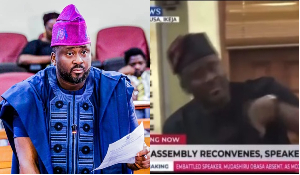
\A member of the Lagos State House of Assembly, Desmond Elliott, has alleged intimidation, political victimisation and the withdrawal of his security aides ahead of the All Progressives Congress (APC) primary election for Surulere I constituency.
In a viral video circulated on Sunday, Mr Elliott accused unnamed party leaders and local government officials of allegedly coercing party members to support a preferred aspirant ahead of the APC House of Assembly primaries scheduled for 20 May.
The lawmaker, who represents Surulere Constituency I in the Lagos State House of Assembly, alleged that some local government officials were removed from their positions because of their support for him.
According to him, the political atmosphere within the Surulere chapter of the APC had become tense due to alleged intimidation and attempts to force party members to support certain candidates.
“Intimidation, coercion, twisting and forcing people to follow their own candidate is what is existing today in Surulere,” Mr Elliott said in the video.
“Telling them that they will not be beneficiaries of some empowerment that is coming some other time. Please, this is not done and should not be done.”
The actor turned politician alleged that the local government leadership had openly backed another aspirant months before the primaries.
“It is bad enough that the LGA and the local government already took a side months ago. The local government already took a side to support a particular aspirant,” he stated.
Mr Elliott also claimed that several individuals associated with him had allegedly suffered repercussions because of their political alignment.
“We’ve been intimidated so much so that a lot of people from the local government have been fired because they follow me,” he alleged.
The lawmaker further alleged that his security personnel were withdrawn under unclear circumstances.
“My security personnel were taken away from me yesterday for reasons best known to them. Now I am left alone to myself. What have I done?” he queried.
He also raised concerns over possible violence during the primaries, alleging that some persons planned to mobilise outsiders to disrupt the exercise.
“They are coming out to fight us. They want to bring people from outside and from within to cause mayhem and trouble,” he alleged.
Mr Elliott appealed to party leaders to intervene and ensure that the primaries are peaceful, transparent and credible.
“I want to ask our party chieftains, please investigate this matter,” he said.
Despite the allegations, the lawmaker said he would accept the outcome of the primaries if the process is free and fair.
“By the grace of God, if I, Desmond Olusola Elliott, win, Alhamdulillah. If I lose, I will throw my support behind the winner. But please let it be under a free and fair election,” he added.
He also urged his supporters not to be intimidated, assuring them that adequate security would be provided during the exercise.
Mr Elliott further used the video to campaign for other APC candidates, including Wasiu Eshilokun, Kadri Hamzat and Bola Tinubu.
Earlier, the Director-General of the Desmond Elliott Campaign Organisation, Bless Koye, announced his withdrawal of support for the lawmaker’s fourth-term bid.
Mr Koye declared his support for Barakat Odunuga-Bakare, an APC aspirant for Surulere Constituency I in the Lagos State House of Assembly.
“I’ll decamp from Desmond group to Barakat group,” Mr Koye reportedly said while announcing his decision.
Background
The latest controversy comes days after Mr Elliott publicly apologised to Femi Gbajabiamila over his alleged involvement in moves to impeach Lagos Assembly Speaker, Mudashiru Obasa.
Mr Gbajabiamila had claimed that he nearly lost his position as Chief of Staff to President Tinubu because of Mr Elliott’s alleged role in the impeachment plot.
According to reports, Mr Gbajabiamila said President Tinubu informed him about Mr Elliott’s alleged involvement, which he initially denied until the State Security Service (SSS) reportedly confirmed it.
Reacting during an appearance on TVC’s Your View, Mr Elliott apologised to the president’s chief of staff, describing him as his political mentor.
“The Gbaja this and Gbaja that of the world. My own baba. I know you’re upset, and I want to say I’m sorry in front of everyone,” he said.
“And I grew up learning everything I knew in politics through him.”
Mr Elliott also hinted during the interview that he was seeking another term in the Lagos Assembly.
👉 Are You A WhatsApp User? Do You Want To Get Our News As Fast As Possible On Daily Basis? 👉 Click This Link To Join WhatsApp Channel Now.

Follow This Instruction: If you are reading from PHOENIX App, Please kindly click the Read Original Button at the top right to read the full content of this article. God bless you.
Oil prices rose to $109.3 on Sunday amid the unending tension in the Middle East, data by Oilprice.com has shown.
This was as the United States President, Donald Trump, warned Iran that the “clock is ticking” after talks to bring the war to an end continued to stall.
From about $107 a barrel last week, oil prices continue to go higher, impacting the cost of refined petroleum products at the pump.
Recall that Trump had last week rejected the proposal by Iran to end the crisis and reopen the all-important Strait of Hormuz. Iran has remained in control of the strait since the war started in February, making oil transportation impossible.
On Sunday, Trump warned Iran to act fast or lose everything. “They better get moving FAST, or there won’t be anything left of them. TIME IS OF THE ESSENCE!” he wrote on his Truth Social platform.
The BBC reports that the message came as the president was due to speak with Israeli Prime Minister Benjamin Netanyahu on Sunday.
Trump warned earlier that the ceasefire agreed with Iran was on “massive life support” after rejecting Tehran’s demands to end the war.
Trump had labelled the Iranian response to US proposals “totally unacceptable”.
An Iranian foreign ministry spokesperson, Esmail Baghaei, insisted the response was “responsible” and “generous”.
According to Iran’s semi-official Tasnim news agency, it includes an immediate end to the war on all fronts, a reference to the continued Israeli attacks against Iran-supported Hezbollah in Lebanon, a halt to the US naval blockade of Iranian ports and guarantees of no further attacks on Iran.
It also reportedly includes a demand for compensation for war damage and an emphasis on Iranian sovereignty over the Strait of Hormuz.
Trump said Chinese President Xi Jinping had agreed Tehran must reopen the Strait of Hormuz, though China gave no indication it would weigh in.
Iranian Foreign Minister Seyyed Abbas Araghchi stated that the Strait of Hormuz remains open to commercial traffic, but ships must cooperate with the Iranian Navy and the authorities while navigating the region.
About 30 Chinese vessels transited the strait on Wednesday.
👉 Are You A WhatsApp User? Do You Want To Get Our News As Fast As Possible On Daily Basis? 👉 Click This Link To Join WhatsApp Channel Now.
Follow This Instruction: If you are reading from PHOENIX App, Please kindly click the Read Original Button at the top right to read the full content of this article. God bless you.
The Chairman of Unilever Nigeria Plc, Bolaji Balogun, has attributed the growth of the company in the 2025 financial year to operational resilience.
This followed the shareholders’ approval of dividends at the company’s Annual General Meeting held in Lagos on Friday, 15 May 2026.
During the AGM, Balogun revealed that each shareholder would receive a final dividend of N3.25 per share, in addition to the interim dividend of 50 kobo per share received earlier in the year.
Consequently, the total dividend payout per share for the 2025 financial year amounted to N3.75.
Financial results indicated that the company achieved a turnover of N214.30bn for the financial year, a significant increase from the N149.52bn reported in the corresponding period of 2024. Profit for the year also grew over twofold, reaching N32.20bn, up from N15.14bn in 2024.
The chairman noted that the results were driven by capacity-expansion investments across various categories, in line with the company’s long-term goals. He described the dividend payment as a reflection of the company’s progressive policy of rewarding shareholders while committing to a long-term strategy of continued investment in sustainable growth.
Speaking on the results, the Managing Director, Unilever Nigeria Plc, Tobi Adeniyi, described the company’s performance as a habit built on the daily execution of its operations by leveraging its power brands to ensure differentiation in the marketplace.
“This performance was driven by a strategic focus on high-growth categories and power brands, supported by sharper choices, simplified ways of working, and a stronger innovation pipeline,” Adeniyi added.
In his remarks, the Finance Director, Unilever Nigeria Plc, Ibrahim Sodipe, stated that the company’s performance over the past five years had been consistent, leading to volume growth driven by innovation and operational efficiency, which ultimately resulted in improved shareholder returns.
A shareholder who spoke at the meeting, Kolawole Durojaiye, lauded the entire management team for the discipline demonstrated in running corporate operations, noting that it had led to improved revenue, profitability, and increased dividend payments.
👉 Are You A WhatsApp User? Do You Want To Get Our News As Fast As Possible On Daily Basis? 👉 Click This Link To Join WhatsApp Channel Now.
Follow This Instruction: If you are reading from PHOENIX App, Please kindly click the Read Original Button at the top right to read the full content of this article. God bless you.
The Central Bank of Nigeria says 63.3 per cent of Nigerians want interest rates reduced ahead of the Monetary Policy Committee meeting scheduled for May 19 and 20, 2026.
The apex bank disclosed this in its April 2026 Inflation Expectations Survey Report, released by its Statistics Department under the Economic Policy Directorate on its website and obtained by The PUNCH on Sunday.
The report found that most respondents preferred lower borrowing costs despite persistent inflationary pressures across the economy. It stated, “The survey revealed high public engagement with CBN communications (92.1 per cent), a general perception of transparency (93.3 per cent), and a strong desire for a reduction in interest rates (63.3 per cent).”
According to the report, 26.0 per cent of respondents wanted interest rates retained at current levels, while 10.7 per cent supported a further rate hike. The development comes as the MPC prepares to take another decision on the Monetary Policy Rate amid concerns over inflation, exchange rate pressures, insecurity, and rising energy costs.
The survey showed that inflation perception worsened in April 2026, with 67.2 per cent of respondents describing inflation as high, up from 56.4 per cent recorded in March 2026.
The CBN noted that the Inflation Perception Index stood at 40.5 points in April, indicating that respondents still considered inflation elevated. It stated, “The Inflation Perception Index stood at 40.5 points in April 2026, suggesting that respondents still perceive inflation as high.”
The report further showed that inflation concerns were more pronounced among households than businesses. It stated that the proportion of households that perceived inflation as high increased from 61.7 per cent in March to 68.8 per cent in April, while the figure for businesses rose from 51.9 per cent to 65.9 per cent within the same period.
Analysis by business size showed that micro businesses recorded the highest inflation perception at 69.9 per cent, while medium businesses had the lowest at 63.2 per cent. The survey also revealed a sharp disparity across income groups.
According to the report, households earning below N70,000 monthly recorded the highest inflation perception at 77.9 per cent, while respondents earning between N250,001 and N350,000 reported the lowest perception of high inflation at 46.6 per cent.
Rural households were also more affected, with 70.4 per cent reporting high inflation perception compared to 67.6 per cent among urban households. On the major drivers of inflation, respondents identified energy costs, transportation, exchange rate pressures, insecurity, and infrastructure challenges as the top factors fuelling rising prices.
The report stated, “Business and household respondents identified energy, transportation, exchange rate, and infrastructure as the major drivers of their perceptions of inflation.”
Despite the current inflation concerns, respondents expressed optimism that inflationary pressures could moderate over the next six months.
Further analysis showed that 58.5 per cent of respondents expected inflation to increase next month, while 56.7 per cent and 54.4 per cent expected inflation to rise over the next three and six months, respectively. However, the proportion expecting inflation to decline increased steadily from 11.0 per cent for next month to 20.4 per cent over the next six months.
On expenditure outlook, the report showed that 67.9 per cent of respondents expected spending to rise in the current month, with businesses recording slightly higher expenditure expectations at 69.0 per cent compared to 66.7 per cent for households.
According to the report, the survey covered 3,587 respondents comprising 1,923 firms and 1,664 households selected from the National Bureau of Statistics establishment frame and the National Population Commission’s National List of Enumeration Areas.
Economist and Chief Executive Officer of the Centre for the Promotion of Private Enterprise, Muda Yusuf, said while inflationary pressures and rising liquidity ahead of the 2027 elections may push the Monetary Policy Committee towards retaining its tight stance, further monetary tightening could hurt economic growth and private sector investment.
In a statement issued on Sunday ahead of the 305th MPC meeting, Yusuf said the committee would likely consider “heightened geopolitical uncertainties and emerging fiscal liquidity risks” in taking its decision.
Yusuf stated, “Accordingly, there is a strong possibility that the Committee may be inclined towards a cautious tightening bias or a prolonged retention of the current tight monetary stance in order to contain inflation expectations, reinforce policy credibility and sustain investor confidence.”
However, he warned against additional rate hikes, saying the economy remained fragile and structurally constrained.
“The Nigerian economy remains fragile and structurally constrained. Further tightening of monetary conditions could significantly weaken credit expansion, dampen investment appetite, and undermine the fragile recovery momentum within the real sector,” he said.
According to him, Nigeria’s inflation problem is largely driven by structural and supply-side factors such as energy costs, transportation expenses, logistics bottlenecks, and infrastructure challenges, rather than excessive consumer demand.
He said, “Monetary tightening is generally more effective in addressing demand-pull inflation arising from heightened aggregate demand and liquidity expansion. Its effectiveness in addressing supply-side inflation shocks is considerably more limited.”
Yusuf added that higher interest rates would increase borrowing costs, weaken manufacturing competitiveness, suppress small business growth, and slow investments at a time when the economy required productivity-enhancing investments and job creation.
He urged the monetary authorities to adopt “a carefully calibrated and balanced monetary policy stance that preserves macroeconomic stability while avoiding excessive tightening capable of undermining economic recovery and private sector resilience.”
Analysts at United Capital Plc Research also projected that the MPC would likely retain the current monetary policy stance at its May 19–20, 2026, meeting despite rising inflationary pressures.
In its Monetary Policy Watch report dated May 14, 2026, the firm said the MPC was facing growing pressure to balance inflation control with the need to support economic growth amid global and domestic uncertainties.
The analysts noted that the ongoing United States-Iran crisis had worsened inflationary risks through higher crude oil prices, transportation costs, and logistics expenses.
The report stated, “The MPC’s upcoming decision will largely depend on striking a balance between inflation and economic growth.”
According to the analysts, although rising inflation would ordinarily justify another rate hike, the current inflationary trend is largely supply-driven, making further tightening less effective.
It stated, “Ordinarily, an inflation uptick would justify a rate hike. However, given the external and transitory nature of the current price increases, an increase in the policy rates may be less effective.”
United Capital Research added that exchange rate stability and improving oil production provided some support for maintaining the current policy stance.
The analysts also warned about weakening economic activities, citing Nigeria’s Composite Purchasing Managers’ Index, which fell into contraction territory at 49.4 points in April from 53.2 points in March.
They stated, “If the contraction continues, the outlook suggests weaker business confidence, lower investment activities, and a decline in Gross Domestic Product growth. Under this condition, an expansionary monetary policy may be appropriate.”
The firm projected that the MPC would retain the Monetary Policy Rate at 26.5 per cent, keep the Cash Reserve Ratio for commercial banks at 45 per cent, and maintain the liquidity ratio at 30 per cent. However, it expected an adjustment of the Cash Reserve Requirement on non-TSA public sector deposits to 85 per cent from 75 per cent.
He noted that rising political spending ahead of the 2027 elections, increased election-related expenditures, and improved Federation Account Allocation Committee allocations to states could worsen liquidity conditions and inflationary pressures.
👉 Are You A WhatsApp User? Do You Want To Get Our News As Fast As Possible On Daily Basis? 👉 Click This Link To Join WhatsApp Channel Now.

 Breaking News8 months ago
World’s Youngest Undergraduate is Nigerian JOSHUA BECKFORD, gained admission in Oxford University at the age of Six years
 Breaking News6 months ago
JUST IN: Finally United States President Donald Trump Revokes 80,000 Visas of Nigerians, Other Foreign Nationals

 Breaking News8 months ago
BREAKING NEWS: Woman in Trouble For Burning 7-year-old Girl’s Private Parts With Hot Knife
 Breaking News8 months ago
BREAKING NEWS: FULL DETAILS! Top Secret Leaked Why SIM Fubara Fails to Return to Government House After Reinstatement

 Breaking News6 months ago
BREAKING NEWS: Nigerian Billionaire Lawmaker Ned Nwoko, Orders Arrest of His Mother In Law Regina Daniels’ Mother, Rita
 Breaking News8 months ago
BREAKING NEWS: Federal Government Releases Proof of N25,000 Cash Transfers to 71 Million Nigerians in 8.1 Million Households
 Breaking News8 months ago
BREAKING NEWS: Another Rivers Saga: Just Reinstated Fubara Told to Sack All Sole Administrators Appointees, Seek Tinubu’s Assurance Over Impeachment
 Breaking News8 months ago
BREAKING NEWS: Finally Department of State Services (DSS) summons Sowore over post on Tinubu