
Breaking News
Politicians get rich while we suffer – so I helped bring down our government in 48 hours

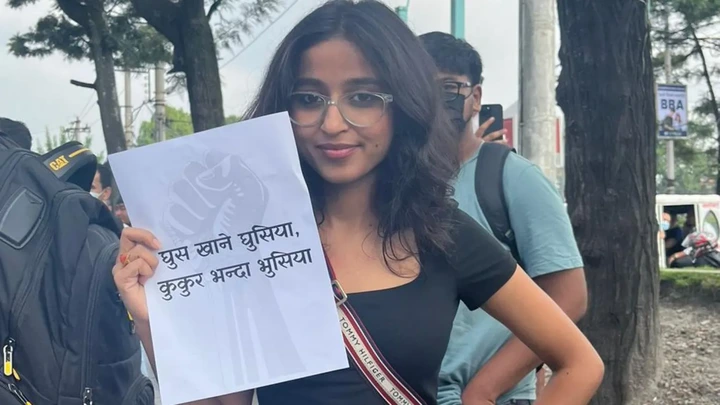
Tanuja Pandey Tanuja Pandey holding a paper showing an anti-corruption slogan during the Gen-Z protests in Nepal
Tanuja Pandey holds up an anti-corruption slogan during protests last week. Nepal’s Gen Z protesters brought down a government in under 48 hours – but the victory has come at a heavy price.....TAP TO CONTINUE READING
Quickly Watch Before It’s Deleted! See The Hidden Secret And What Will To Nigeria and United States On The 17th of November 2025. It Will Shock You.
“We are proud, but there is also a mixed baggage of trauma, regret and anger,” says Tanuja Pandey, one of the protest organisers.
With 72 people killed, last week’s protests were the deadliest unrest in the Himalayan country in decades. Official buildings, residences of political leaders and luxury hotels such as the Hilton, which opened in July 2024, were torched, vandalised and looted. The wife of a former prime minister is fighting for her life after their home was set ablaze.
The protests represented “a wholesale rejection of Nepal’s current political class for decades of poor governance and exploitation of state resources”, said Ashish Pradhan, a senior adviser at the International Crisis Group. But the damage to government services, he added, could “parallel the toll of the 2015 earthquake which took almost 9,000 lives”.
The destruction is not only confined to the capital Kathmandu – at least 300 local government offices across the nation have been damaged.
The financial losses could amount to 3 trillion Nepalese rupees ($21.3bn; £15.6bn), nearly half of the country’s GDP, according to the Kathmandu Post. Its offices were also attacked by crowds and set on fire.
Saugat Thapa, in a red sweater and black trousers, stands next to a Christmas tree made of boxes of luxury brands
Enraged by the huge inequality, young Nepalis have been calling the children of politicians “nepo babies”
‘Nepo babies’
Two days before the deadly demonstration on 8 September, Ms Pandey, a 24-year-old environmental campaigner, uploaded a video showing a mining site in Chure, one of the most fragile mountain ranges in the region. Nepal’s resources should belong to the people, not to “politicians’ private limited companies”, she wrote, calling on her peers to “march against corruption and the misuse of our nation’s wealth”.
Like many youth movements in Asia, Nepal’s Gen Z protests were leaderless. Others had made similar pleas to Ms Pandey’s after the Nepali government decided to ban 26 social media platforms, citing their failure to register locally.
For months, fury had been brewing against “nepo babies”, the children of powerful politicians of all stripes, who were accused of flaunting their unexplained wealth on social media.
One of the most viral photos showed Saugat Thapa, the son of a provincial minister, standing next to a Christmas tree made of boxes of luxury brands including Louis Vuitton, Gucci and Cartier. In response, he said it was “an unfair misinterpretation” and his father “returned every rupee earned from public service to the community”.
Ms Pandey had watched almost all “nepo babies” content, but one video juxtaposing the luxurious life of a political family and an ordinary young Nepali who had to find work in a Gulf country struck her.
“It is painful to watch, especially knowing that even educated youth are forced to leave the country because wages here are far below what one needs to live with dignity,” she said.
Nepal is a young democracy. It became a republic in 2008, after a decade-long, Maoist-led civil war that killed more than 17,000 people.
But the promised stability and prosperity have not materialised. In 17 years, Nepal has had 14 governments, and no leader has completed a full five-year term. The country’s politics resemble a game of musical chairs, with communist parties and the centrist Nepali Congress taking turns to rule. Three leaders, including KP Sharma Oli who resigned over the Gen Z protests, returned to power multiple times.
Nepal’s GDP per capita remained under $1,500, making it the second-poorest country in South Asia, behind only Afghanistan. An estimated 14% of the population work overseas, and one in three households receives remittances.
Ms Pandey comes from a middle-class family in eastern Nepal and her father is a retired government teacher. Three years ago, she was diagnosed with a brain tumour, for which she is still receiving treatment. The medical bills nearly bankrupted her family, so her older sister moved to Australia to support them.
Before the protests, Ms Pandey worked with others to create guidelines stressing non-violence and respect and reminding participants to stay vigilant against “hijackers”.
On the morning of 8 September, she arrived at Maitighar Mandala, a huge traffic island in central Kathmandu with several of her friends. She was expecting thousands would turn up at most – but the crowds kept swelling.
Aakriti Ghimire, a 26-year-old protester, said things were initially peaceful and communal. “We were all seated, we were singing old Nepali songs,” she said. “The slogans and everything were so funny, we were enjoying it. And after that, we started to march… the police were there to ensure that there were no vehicles disturbing us.”
Both Ms Pandey and Ms Ghimire started to sense danger at around midday, when crowds began moving to New Baneshwor, the neighbourhood housing parliament. Both saw people arriving on motorbikes, and Ms Pandey said these people appeared older than average Gen Z protesters.
Ms Ghimire believes they were infiltrators. “It became very tricky for us to distinguish the peaceful protesters – some people who genuinely came for something – versus those who came in with the intention of being violent.”
When some protesters tried to breach the security around parliament, police fired tear gas, water cannon and shots in return. There is evidence live rounds were used and they are accused of shooting at schoolchildren as well. An investigation into what happened is under way.
Reuters
Reuters Smoke rises from the burnt Hilton Kathmandu hotel, following protests against Monday’s killing of 19 people after anti-corruption protests triggered by a social media ban
The Hilton was one of the targets of arsonist attacks
Chaos and violence reigned the next day. Demonstrators retaliated by setting parliament, the prime minister’s office and other government buildings ablaze. Both Ms Pandey and Ms Ghimire stayed indoors and watched the developments online.
“A lot of people did share that it felt so good to finally see politicians face the consequences of everything they’ve done,” Ms Ghimire said, referring to the destruction of the leaders’ homes. But the mood soon darkened.
“I saw people with bottles filled with petroleum. They got it from the motorbikes. They started attacking the parliament,” said Ms Pandey.
The law graduate cried after seeing the Supreme Court on fire, saying that it was like “a temple” for her. Her friends at the scene were pouring water on the flames to try to put them out. They all knew the effort would be futile – they did it only to console themselves.
“People say the arsonists intended to come and burn these things… Who are these people?” asked Ms Ghimire. “The videos show these people are all masked.”
Some calm was restored when the army was deployed to take control of the situation – a curfew was in place for days. Later in the week former Supreme Court Chief Justice Sushila Karki was appointed interim prime minister. She had been backed by protesters for the post.
Ms Pandey hopes she “can lead the country efficiently, do the election in stipulated time and hand the power to the people”.
But the anxiety about Nepal’s political future persists.
Rumela Sen, a South Asia expert at Columbia University, said it was “worrying” to see “an unprecedented glorification of the army as a voice of sanity and stability”.
Many are also uncomfortable with the involvement of Durga Prasai in the initial negotiation at the invitation of the military. Mr Prasai was arrested for his role in violent pro-monarchy protests in March. He fled to India but was returned to Nepal. The Gen Z protesters walked out.
Reuters People take part in a candlelight vigil in memory of people who died during the protest against anti-corruption triggered by a social media ban
Reuters
“We are deeply shocked because we have lost our beloved son,” said Yubaraj Neupane, whose 23-year-old son Yogendra died in the protests. “I am yet to find out how he died.”
Yogendra was shot in the back of the head near the parliament building, according to the post mortem report.
From south-eastern Nepal, the family’s eldest son had pursued his studies in Kathmandu and aspired to be a civil servant. He was always studying, friends and relatives said.
But on 8 September, he joined the protests with his friends, dreaming of bringing change to the country. His family didn’t know he was at the scene until he called them after the situation started heating up.
“Our beloved has lost his life calling for change,” his great-uncle Saubhagya said. “His blood and sacrifice should be recognised so that other young people won’t have to hit the streets again in the future.”
Ms Pandey said she was cautiously optimistic about her country’s future, but the trauma of the past week would stay with her for the rest of her life.
This is a political awakening for her generation.
“We are no longer willing to stay silent or accept injustice,” she says. “This is not just a gentle nudge; it’s a bold challenge to a system that has hoarded power for decades.”
Quickly Watch Before It’s Deleted! See The Hidden Secret And What Will To Nigeria and United States On The 17th of November 2025. It Will Shock You.
Read The Full Article Here Now
👉 Are You A WhatsApp User? Do You Want To Get Our News As Fast As Possible On Daily Basis? 👉 Click This Link To Join WhatsApp Channel Now.

Art & Commercial students don’t fail JAMB because they’re dull. They fail because they’re taught like Science students. Science students calculate — JAMB rewards that. Art students explain — JAMB doesn’t. So you read hard, attend lessons, yet your score disappoints you. This online class fixes that. No theory overload. No confusion. Just real JAMB questions, clear breakdowns, and winning strategies. 📌 JAMB is not hard — you were just taught the wrong way.Click The Link To Reach Us Now 👉 https://wa.me/2349063958940
The Kano State Government has announced that the Emir of Kano, Muhammadu Sanusi II, will lead this year’s Eid-el-Fitr Durbar, even as it unveiled strict guidelines to prevent a breakdown of law and order during the celebrations.....TAP TO CONTINUE READING
The government said the decision, approved by Governor Abba Kabir Yusuf, followed credible intelligence reports indicating attempts by some individuals to create unrest during the Sallah period.
In a statement issued on Wednesday by the Commissioner for Information and Internal Affairs, Ibrahim Abdullahi Waiya, the government said it remained committed to preserving Kano’s cultural heritage but would prioritise peace and security.
According to the statement, Hawan Idi (Eid Durbar) will be conducted by Emir Sanusi from the Kofar Mata Eid Ground through designated routes to Gidan Shettima, terminating at Kofar Fatalwa of the emir’s palace.
It added that Hawan Nasarawa would be held in a modified form without horseback displays, while Hawan Daushe, Hawan Fanisau and Hawan Dorayi have been suspended for the time being in the interest of public safety.
The government said all security agencies had been directed to intensify surveillance and ensure strict compliance with the directives before, during and after the festive period.
It urged residents to remain calm, law-abiding and cooperative with security agencies, while cautioning against the spread of unverified information.
The government further assured the public of its commitment to a peaceful and hitch-free Sallah celebration, wishing Muslims in the state a joyous Eid-el-Fitr.
The Durbar, a centuries-old cultural procession, has been thrown into uncertainty following conflicting statements from government officials on whether it will hold this year, given the unresolved legal battle between Sanusi II and Aminu Ado Bayero.
While Governor Yusuf reinstated Sanusi II in 2024, Bayero continues to contest his dethronement in court, leaving the emirship in dispute.
The government recently hinted that the stool controversy would soon be resolved.
Read The Full Article Here Now
👉 Are You A WhatsApp User? Do You Want To Get Our News As Fast As Possible On Daily Basis? 👉 Click This Link To Join WhatsApp Channel Now.
Art & Commercial students don’t fail JAMB because they’re dull. They fail because they’re taught like Science students. Science students calculate — JAMB rewards that. Art students explain — JAMB doesn’t. So you read hard, attend lessons, yet your score disappoints you. This online class fixes that. No theory overload. No confusion. Just real JAMB questions, clear breakdowns, and winning strategies. 📌 JAMB is not hard — you were just taught the wrong way.Click The Link To Reach Us Now 👉 https://wa.me/2349063958940
Yoruba nation agitator, Sunday Adeyemo, popularly known as Sunday Igboho, has dismissed comments by human rights activist and former presidential candidate, Omoyele Sowore, over what he described as transactional politics and activism.....TAP TO CONTINUE READING
PUNCH Online reports that Sowore’s comment followed a viral video in which the activist criticised what he described as “transactional politics” among some regional agitators and influencers, accusing them of aligning with political actors for personal or material benefit.
In the video, Sowore appeared to reference Igboho, suggesting that his recent political positions, including support for President Bola Tinubu’s potential re-election bid, reflected what he termed “amala politics” — a colloquial expression often used to imply opportunistic or interest-driven engagement rather than principled activism.
Igboho, in a statement issued by his media aide, Olayomi Koiki, in Ibadan, the Oyo State capital, on Tuesday, criticised Sowore for allegedly describing his activism as “amala politics” in a recent viral video circulating on social media.
He described the comment as an inconsequential rant that should be ignored by the public.
Igboho argued that his agitation for improved security in the South-West and his support for the second-term bid of President Bola Tinubu in 2027 were constitutional rights aimed at promoting the collective interests of the Yoruba people and the development of Nigeria.
He said, “We strongly reject the characterisation of Igboho’s activism as transactional. Such a myopic position misrepresents the intent and focus of our agitation on effective grassroots security in the South-West and Nigeria as a whole.
“How many protests did Sowore organise to push for my freedom? Sowore’s claim of fighting for the masses contradicts his alleged daily lodging expenses of N450,000 at a popular Lagos hotel.
“I cannot be compelled to endorse political figures such as Peter Obi or Atiku Abubakar, or even align with Sowore’s political platform. I have the right to make independent political decisions based on the security and collective interests of the Yoruba people.”
He added that Igboho’s advocacy prioritises addressing insecurity across Yorubaland, including killings of farmers, kidnappings along highways and attacks on traditional rulers and royal institutions.
Koiki, however, clarified that these concerns form the basis of Igboho’s movement rather than any ambition for political office or revolutionary leadership.
The statement added, “While Sowore has consistently promoted nationwide revolution as a pathway to leadership, Igboho’s approach is rooted in protecting lives, land and property within Yoruba territory. This agitation is a response to real and ongoing threats faced by communities in the region.
“Latest security incidents in northern Nigeria, including reported explosions in Maiduguri on March 16, 2026, also raise questions about the broader effectiveness of long-term revolutionary advocacy.
“We challenge Sowore to assess the situation in his home state of Ondo State, considering the growing cases of banditry, kidnapping and attacks on rural communities.”
The statement added that the impact of insecurity on vulnerable groups, including farmers, traditional rulers, women and children, had been severe, with several communities reportedly affected.
“These realities reinforce Igboho’s long-standing call since 2020 for localised security measures and stronger regional protection strategies.
“Labelling our agitation and efforts as ‘amala politics’ undermines the urgency of the security crisis and the legitimacy of grassroots agitation,” the statement concluded
Read The Full Article Here Now
👉 Are You A WhatsApp User? Do You Want To Get Our News As Fast As Possible On Daily Basis? 👉 Click This Link To Join WhatsApp Channel Now.
Art & Commercial students don’t fail JAMB because they’re dull. They fail because they’re taught like Science students. Science students calculate — JAMB rewards that. Art students explain — JAMB doesn’t. So you read hard, attend lessons, yet your score disappoints you. This online class fixes that. No theory overload. No confusion. Just real JAMB questions, clear breakdowns, and winning strategies. 📌 JAMB is not hard — you were just taught the wrong way.Click The Link To Reach Us Now 👉 https://wa.me/2349063958940
The continuous detention of the former governor of Kaduna State, Mallam Nasir El-Rufai, has sparked reactions from politicians and socio-political activists.....TAP TO CONTINUE READING
DAILY POST reports that the former governor has been in the custody of the Independent Corrupt Practices and Other Related Offences Commission, ICPC, over an ongoing investigation into alleged financial impropriety when he was governor.
El-Rufai had earlier spent two nights in the custody of the Economic and Financial Crimes Commission, EFCC, before he was picked up by the Department of State Services and then later handed over to the ICPC.
His continuous detention has sparked outrage among citizens who are calling on the commission to immediately charge the former governor to court.
Popular socio-political activist, Aisha Yesufu, said in a post on X that “holding a citizen indefinitely without trial” is impossible.
According to her, “that is not justice. That is not accountability. That begins to look like persecution.
“Every Nigerian, no matter how powerful or unpopular, has the right to a fair hearing. That right is not a favour from the government. It is a constitutional guarantee. If El-Rufai committed crimes, then prosecute him. Nigerians will support that. But what we must never
Support is a system where the government can detain anyone endlessly, simply because it can.
“Today, it may be El-Rufai. Tomorrow, it could be anyone else who speaks or acts in a way that those in power do not like. A democracy must be better than that.
“So the message is simple: charge him in court or release him. Let justice be done openly, lawfully, and transparently. That is the only way a nation that claims to respect the rule of law should act”.
Similarly, an activist lawyer, Deji Adeyanju, in an interview he posted on X on Wednesday, demanded that the former governor be charged to court immediately, condemning El-Rufai’s incarceration.
“No matter the allegations, I think he should be charged in a court of competent jurisdiction so that he can face the music.
“All these things currently going on don’t look tidy to me”, he said.
On his part, Paul Ibe, a media aide to the former vice president, Atiku Abubakar, lambasted ICPC for not charging the former governor to court.
In a statement on his X handle, Ibe accused the Commission of taking sides with the President Bola Tinubu-led administration.
He wrote, “The matter of the former Governor of Kaduna State, Mallam Nasir el-Rufai @elrufai has proven beyond measure that the ‘I’ in ICPC (Independent Corrupt Practices and Other Related Offences Commission) @icpcnigeria represents Illegal or Irresponsible.
“There’s nothing Independent about the Commission. They’re no different from all the other institutions of state that are standing on Tinubu’s mandate. The ICPC is nauseatingly pliable and has disgracefully made itself available in coercing members of the opposition into the ruling party”!
Read The Full Article Here Now
👉 Are You A WhatsApp User? Do You Want To Get Our News As Fast As Possible On Daily Basis? 👉 Click This Link To Join WhatsApp Channel Now.
Art & Commercial students don’t fail JAMB because they’re dull. They fail because they’re taught like Science students. Science students calculate — JAMB rewards that. Art students explain — JAMB doesn’t. So you read hard, attend lessons, yet your score disappoints you. This online class fixes that. No theory overload. No confusion. Just real JAMB questions, clear breakdowns, and winning strategies. 📌 JAMB is not hard — you were just taught the wrong way.Click The Link To Reach Us Now 👉 https://wa.me/2349063958940
-

 Breaking News6 months ago
World’s Youngest Undergraduate is Nigerian JOSHUA BECKFORD, gained admission in Oxford University at the age of Six years
-
 Breaking News4 months ago
JUST IN: Finally United States President Donald Trump Revokes 80,000 Visas of Nigerians, Other Foreign Nationals
-

 Breaking News6 months ago
BREAKING NEWS: Woman in Trouble For Burning 7-year-old Girl’s Private Parts With Hot Knife
-
 Breaking News6 months ago
BREAKING NEWS: FULL DETAILS! Top Secret Leaked Why SIM Fubara Fails to Return to Government House After Reinstatement
-

 Breaking News4 months ago
BREAKING NEWS: Nigerian Billionaire Lawmaker Ned Nwoko, Orders Arrest of His Mother In Law Regina Daniels’ Mother, Rita
-
 Breaking News6 months ago
BREAKING NEWS: Federal Government Releases Proof of N25,000 Cash Transfers to 71 Million Nigerians in 8.1 Million Households
-

 Breaking News6 months ago
BREAKING NEWS: Another Rivers Saga: Just Reinstated Fubara Told to Sack All Sole Administrators Appointees, Seek Tinubu’s Assurance Over Impeachment
-

 Breaking News6 months ago
BREAKING NEWS: Finally Department of State Services (DSS) summons Sowore over post on Tinubu